Update: The Return of the Immigrant Ancestors Project
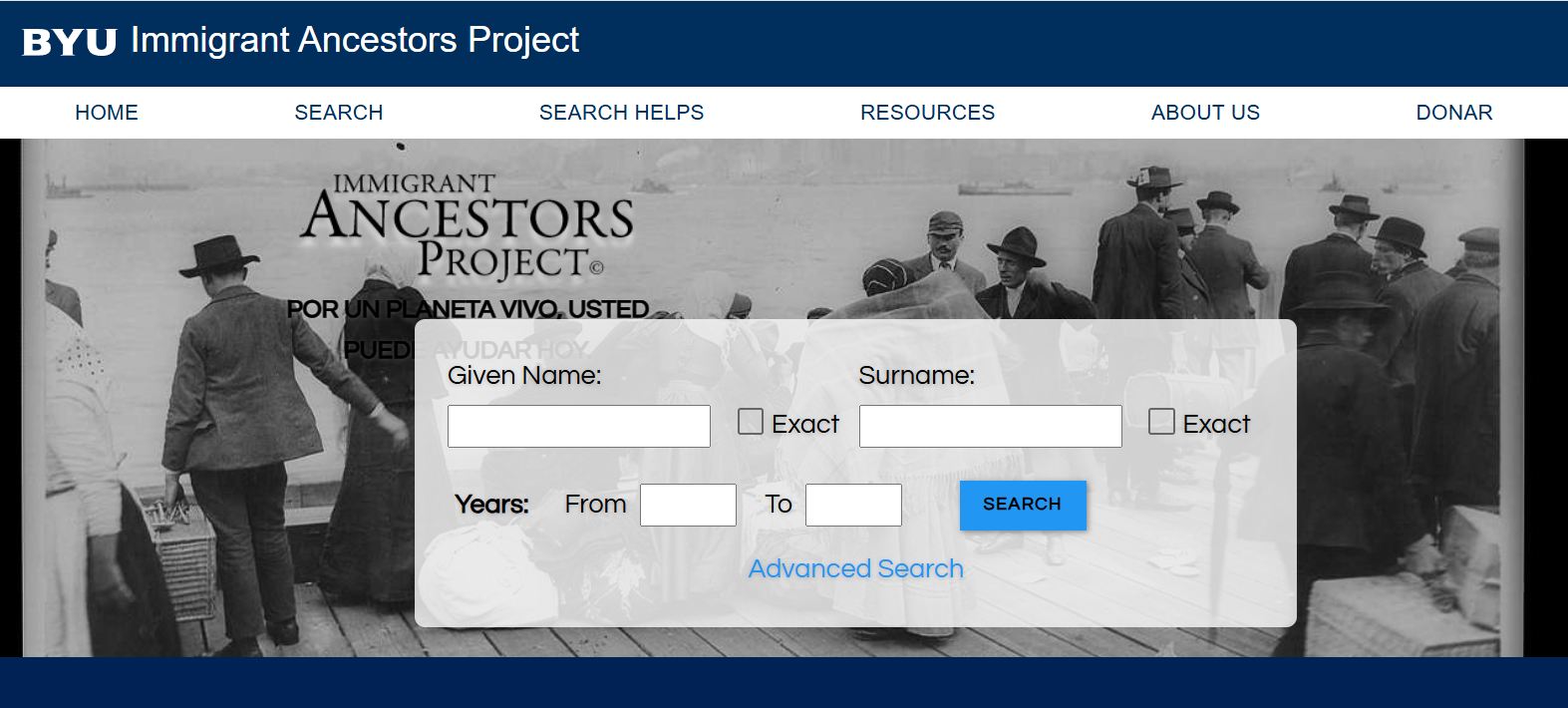
The Immigrant Ancestors Project, which had been taken offline for security reasons, is now available again through a new testing version. This allows partial access to its database, although the website is still under development.
One of the most distinctive features of the project is that it does not focus exclusively on large databases. Instead, it actively searches for small collections of migration records preserved in European archives.
Many of these collections are relatively small—sometimes covering only a few years—and often go unnoticed. Nevertheless, they can contain crucial information about the origins and destinations of emigrants.
What Is the Project?
Many researchers assume that European emigration records will reveal the birthplace of an ancestor. In reality, very few passenger departure lists from European ports have survived, as many were lost or destroyed over time.
The Immigrant Ancestors Project, founded by Professor George R. Ryskamp (†) and sponsored by the Brigham Young University Family History Center (Provo, Utah), has worked since 2004 to:
- Identify European archives related to emigration;
- Digitize historical records;
- Extract emigrant information;
- Create an online searchable database.
The records come from municipal, provincial, departmental, regional, and national archives in countries such as Germany, Spain, Italy, France, Portugal, and the United Kingdom.
A Wide Variety of Records
The project has revealed a remarkable variety of laws, regulations, and administrative practices related to migration. As a result, researchers can access many different types of documents that help explain the requirements emigrants had to meet before leaving their home countries.
Many of these archival collections have only been identified in recent years.
Project Methodology
The work is organized into four main stages:
- Identification of emigration archives;
- Digitization of documents;
- Extraction of individual data;
- Publication in an online database.
The extracted data is reviewed and verified to ensure reliability.
Types of Records Identified
The collections can generally be grouped into three major categories:
- Departure records (country of origin);
- Arrival records (destination country);
- Transit records.
Italian Collections
Naples — Illegal Emigration (1884–1885)
This collection includes passenger lists created by police authorities in connection with clandestine emigration from Naples. The files usually contain the ship name, departure date, passenger lists, and final destination.
These records are particularly valuable because they document migration outside official channels.
Naples — Passport Applications (1888–1901)
This extensive series of passport applications contains individual files that may include personal information about applicants, family members, and travel companions.
The records often provide enough detail to reconstruct family circumstances prior to emigration.
Genoa — Prefecture Records (1858–1872)
This collection consists of administrative records preserved by the Prefecture of Genoa, including passport applications for foreign travel.
The files frequently contain information about both the principal emigrant and accompanying family members.
Turin — Passport Applications (1903–1905)
These records come from passport applications submitted to the Turin Police Headquarters (Questura).
The files may include personal information, supporting documentation, and administrative notes reflecting migration procedures of the period.
Spanish Collections
The project includes more than 42,000 records relating to Spanish emigrants, extracted from a wide variety of sources.
- Official gazettes publishing emigration notices;
- Emigration and immigration cards;
- Residence certificates;
- Passports;
- Embarkation files;
- Emigration files;
- Records of fugitives and deserters;
- Records of deaths abroad;
- Passport applications;
- Emigration permits.
French Collections
France is represented by several collections of particular interest for migration research.
Among the currently available collections are:
- Passport registers from Charente-Maritime (1896–1937);
- Passport records from the Gironde Archives;
- Loire-Atlantique passport collections;
- Foreign passport records from Haute-Marne;
- Passport applications;
- Embarkation registers;
- Haut-Rhin immigration passport records (1817–1866);
- Records of individuals retaining French nationality;
- Registers of foreigners expelled from France;
- Passenger lists for departures to Louisiana;
- Collections preserved in the departmental archives of Bas-Rhin, Haut-Rhin, Charente-Maritime, Gironde, Sarthe, Loire-Atlantique, Pyrénées-Atlantiques, and the Municipal Historical Archives of Cherbourg-Octeville.
Important
Because the new website is still in testing, it is possible that:
- Not all records are currently available;
- Some searches may not function correctly;
- Access may be partial or intermittent.
Even with these limitations, the return of the project is an important development for genealogical research.
Access the Database
The testing version is available at:
The database currently includes records relating to emigrants from Spain, Portugal, Italy, France, and other European countries. Many collections document migration to the United States, Canada, the United Kingdom, Australia, New Zealand, and other destinations around the world.
One of the most valuable features of the project is that many records include both the emigrant’s place of origin and intended destination. The search engine also allows a variety of combined searches, making it easier to identify individuals and reconstruct migration patterns.