Historical database of Friulian families
To allow easier researches, the Archive of the State of Udine has stored online a database; this page offers information about people, with data extracted from acts of marriage (only marriages) from 1871 to 1900, in all the communes of the Province of Udine, with the exception of the area owned by Austria.
To search the site, you must access https://friulinprin.cultura.gov.it/ and then enter the Ricerca persona section. Please note that, in some cases, it may be necessary to use a VPN in order to access the site.
Likewise, a list of the army recruitment data was extracted about the people born between 1846 and 1890 from the Mandamenti de Ampezzo, Cividale, Gemona, Latisana, Moggio, San Daniele, San Pietro, Tolmezzo and Tarcento.
Through this database the ancestors’ personal data and the communes of origin can be found, and the delivery of a copy of the respective civil act can be required. Since the Friuli in prim Project and its data’s uploading is constantly undergoing, it’s possible that some citizens’ information is not yet uploaded.

The Friuli in prin search tool allows users to select the type of search, offering two options: Normal and Estesa.
- Normal search is based on an exact match of the entered name or surname and is useful when the spelling used in historical records is known with certainty.
- Estesa search broadens the results by including orthographic variants and related forms, a feature that is particularly valuable in genealogical research, where surnames could change over time or even within the same family. This option facilitates the identification of family groups and helps resolve cases of homonymy, providing a more complete and realistic view of family history in nineteenth-century Friuli.
Distribution of Friulian surnames
The “Surname distribution” section of Friuli in prin makes it possible to analyze the presence and distribution of a surname across the Friulian territory based on the historical records included in the database. The search tool offers two main fields: surname (cognome) and municipality (comune).
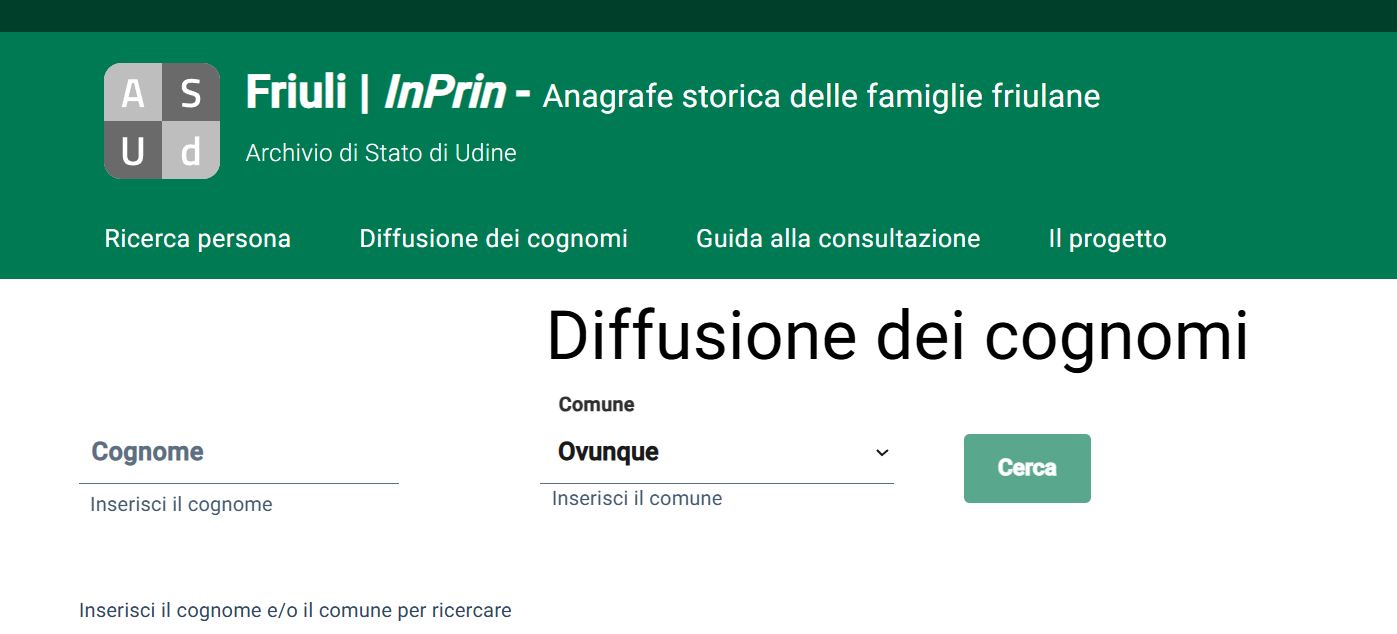
By entering a surname and leaving the municipality field set to Ovunque (anywhere), the system displays the municipalities in which that surname is documented within the area covered by the project. If a specific municipality is selected instead, the search is limited to that location, making it possible to verify whether the surname was present there and in what context. It is also possible to search by municipality alone in order to view the set of surnames documented in that place.
This tool is particularly useful for genealogical and onomastic studies, as it allows surnames to be linked to specific territories and helps to better understand their historical distribution in Friuli between the nineteenth and early twentieth centuries.
If the ancestor was born before 1850 is displayed on the list only as “father” or “mother”, and should be researched in this character on the list In the case of some marriage was not found on the list, it’s important to take account that until the Concordat (1929) not all of the marriages were registered as civil acts. The Concordat was part of the Lateran Treaty, an agreement signed by the Pope and Benito Mussolini which, among other attributions, recognized the validation of religious marriages.
Friulan Roots
The Friulan Roots blog focuses on the history and genealogy of northeastern Italy, particularly the areas of San Vito al Tagliamento and Valvasone. It offers transcriptions and analyses of marriage records and other historical documents, including details such as dates, names, places of birth, and family relationships. The blog also provides links to PDF documents hosted on Google Drive and explains how to interpret the information found in old records, emphasizing the importance of accuracy in genealogical research.