The New Geography of Surnames in Italy: Identity, Migration, and Citizenship
In 21st-century Italy, cultural diversity is no longer limited to major cities—it has become a defining element of national identity. Today, over 5 million foreign nationals live in Italy, representing more than 8% of the population. This means that, for every hundred people living in the country, at least eight are not—or not yet—Italian citizens.
This phenomenon is reshaping not only the social fabric of Italy but also its onomastic landscape. In several Italian cities, surnames of foreign origin have begun to top official statistics.
In Milan, the country’s second most populous city, the surname Hu, of Chinese origin, ranks among the most common. In Brescia, a key city in northern Italy, the surname Singh, typical of Indian and Pakistani communities, is particularly widespread. And in Prato, a central Italian city known for its large Chinese population, the surname Chen is frequently encountered.
Ius Sanguinis and the Making of Citizenship
Italian law follows the principle of ius sanguinis (“right of blood”), meaning that citizenship is passed down through ancestry. Children born in Italy to foreign parents do not automatically acquire Italian nationality but rather inherit the nationality of their parents. However, upon turning 18, if they have lived legally in the country since birth, they may apply for Italian citizenship.
This process represents a significant turning point. Many young people born in Italy with diverse surnames and backgrounds will become Italian citizens, and as a result, their surnames will become part of Italy’s official onomastic repertoire. In this way, surnames once considered “foreign” will, over time, also become “Italian.”
Surnames as Narratives of Contemporary Migration
The most common surnames among recent immigrant communities reflect the wide range of backgrounds now present in Italy: Moroccan, Tunisian, Egyptian, Romanian, Moldovan, Ukrainian, Albanian, Bosnian, Serbian, Senegalese, Ghanaian, Indian, Pakistani, Bengali, Sinhalese, Filipino, Ecuadorian, Peruvian, Cuban, among others.
Each of these surnames is more than just an administrative label—it is a story of migration, of roots, of resilience, and of adaptation. They represent families who, through work, education, and social participation, are helping to shape a more pluralistic, vibrant, and open Italy.
Global Roots: Common Surnames in Italy Today
Chinese, South Asian, and Sri Lankan Surnames
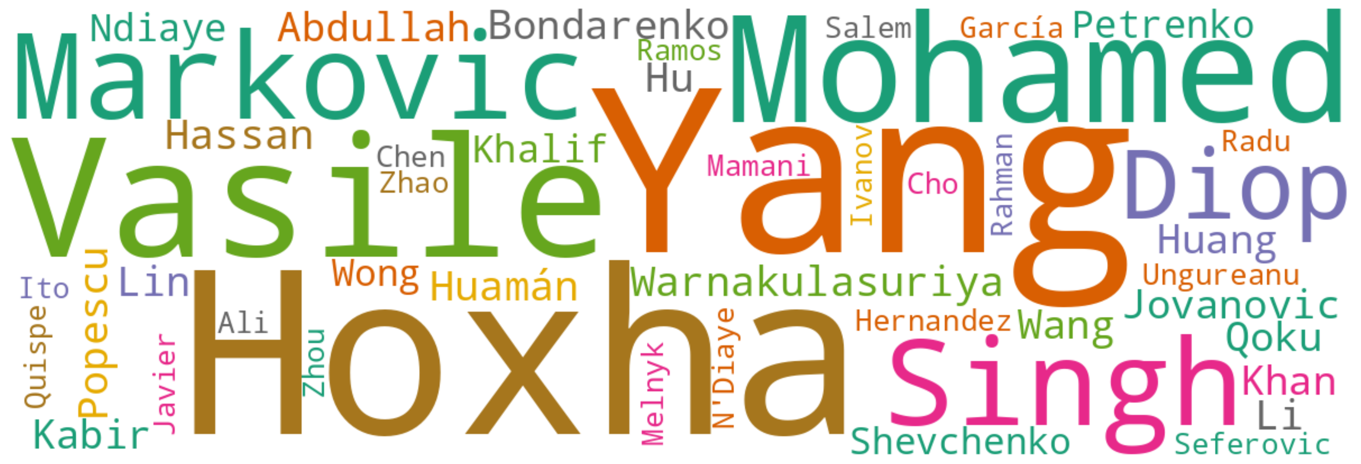
The Chinese-origin surnames present in the image are Zhao, Huang, Hu, Wang, Chen, Yang, Lin, and Zhou — all of which are very common in various regions of China and among Chinese communities abroad. Of Indian or South Asian origin, we find Singh, Rahman, Kabir, and Khan, which are used in India as well as in Pakistan and Bangladesh. Also from South Asia, but more specifically from Sri Lanka, is the surname Warnakulasuriya, characteristic of the Sinhalese ethnic group.
Arab, African, and Slavic Surnames in Italy
Among surnames of Arab or Islamic origin, Mohamed stands out, widely used in Muslim countries as both a given name and a surname. From West Africa, Diop and Ndiaye are typical surnames of Senegal. From the Albanian context, there are Hoxha and Qoku, while the surnames Jovanovic, Markovic, and Seferovic belong to the Slavic tradition of southeastern Europe, particularly countries such as Serbia, Montenegro, and Bosnia.
Romanian and Hispanic Surnames
Also from this region is the surname Ungureanu, of Romanian origin, along with Popescu, Vasile, and Radu, all highly representative of Romania. Finally, Hernandez and Javier are surnames of Hispanic origin, common in Spanish-speaking countries such as Spain, Mexico, and Argentina.