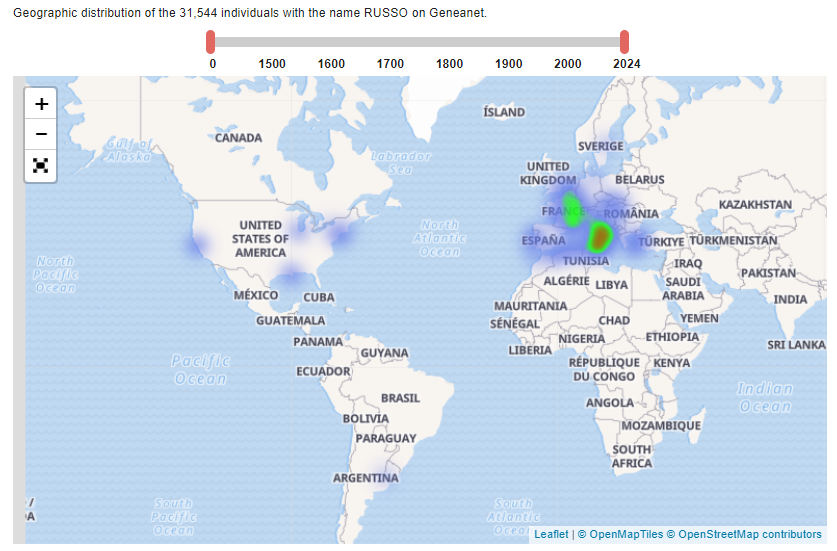
Surname heat maps

In a previous post we referred to Italian surname maps, in this post we will talk about the heat maps of surnames of the Geneanet website, being this tool considered the “Google Maps of surnames”.
Geneanet’s surname heat maps
A heat map is a visual representation of data where values are shown with colors. The more intense or darker the color, the higher the value represented. This tool helps to quickly identify patterns and areas of high concentration in a data set.
Geneanet is a specialized genealogy platform, created in 1996, with a community of more than 5 million members sharing their genealogical information for free: more than 8 billion people in their family trees, digitized archival documents, family photos, indexing of documents. The site also offers a premium subscription.
Heatmaps are visual tools that show the geographic distribution and density of surnames in different regions and epochs, helping users to better understand the dispersion and concentration of surnames over time. How heat maps work and what information they provide Surname heat maps in Geneanet are based on a large database of genealogical records provided by users, therefore, these data should be considered as approximate, as they do not come from the indexing of local or regional records such as censuses, parish records, etc.
How do these heat maps work and what information can they provide?
- Geographic Distribution: heat maps illustrate where surnames are most commonly found. They use colors to represent density, with more intense colors indicating a higher concentration of people with that surname in a specific region.
- Temporality: allows you to see how the distribution of a surname has changed over time, showing patterns of migration and settlement of families over different historical periods.
- Scale: These can be at the local, regional, national or even international level, depending on the data available on the platform.
- Interactivity: Users can interact with the maps by zooming in or out, and can sometimes click on specific areas to get more information about people with that surname in that region. Explore the map: The map will show you the geographic distribution of surnames. You can adjust the parameters and explore different regions and time periods.
- Identify variants: Recognizing variants or deformations of a surname is essential in genealogical research, as it helps to locate records in different forms, increasing the chances of finding relevant and accurate information about ancestors. These maps are especially useful for genealogists and people interested in tracing their family roots, as they provide a visual and accessible way to understand how their ancestors may have moved and settled in different places.