Snow and Birth Records in the 19th Century
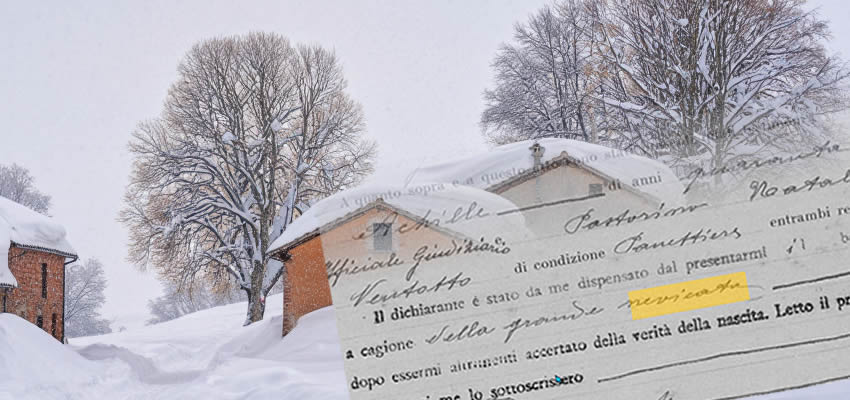
Snow is often associated with beauty and silence. Yet, both in the past and today, it has also caused isolation, delays, and difficulties in everyday life. In 19th-century Italy, these disruptions were not only experienced — they were documented.
The Gazzetta Ufficiale and meteorological reports
During the 19th century, the Gazzetta Ufficiale did not publish only laws and decrees. Its pages also included official reports issued by the Central Office of Meteorology and Geodynamics, which recorded exceptional weather events.
These reports described heavy snowfall, extreme cold, frozen rivers, impassable roads, and disrupted communications. They were not weather forecasts, but retrospective reports, written after the events had occurred in order to leave an official administrative record.
For this reason, it is not unusual today to find copies of the Gazzetta Ufficiale bound together with civil registration books, especially in municipal and judicial archives.
The Ordinamento dello Stato Civile and birth registration
The Ordinamento dello Stato Civile, published in 1865, established precise rules for the registration of births in the Kingdom of Italy. Among them, it stipulated that:
-
the newborn had to be presented before the civil registrar,
-
and the birth had to be declared within five days after delivery (calendar days).
This time limit reflected the administrative logic of the period, but the law also acknowledged that real life did not always allow it to be met.
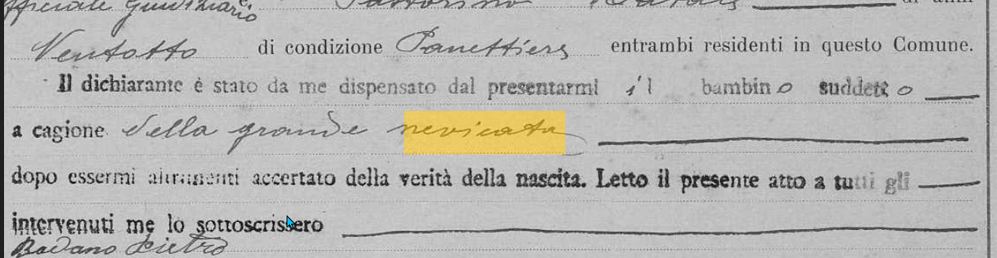
Legal exemptions and justified delays
The legislation itself provided for exemptions in cases where there were justified reasons. Among these, adverse weather conditions played a significant role.
When snow, severe cold, or isolation made it impossible to:
- bring the newborn to the registrar,
- present the child in person,
- or comply with the legal deadline,
the birth could be:
- registered without the physical presentation of the child, or
- recorded after the legal time limit,
always with an explicit statement of the reason included in the act.
These formulas, which are frequently found in historical records today, do not indicate mistakes or negligence. They are the written trace of harsh winters and of a legal system that anticipated exceptional circumstances.
When climate also becomes part of the archives
The snowfalls of the 19th century did not only shape landscapes and communities — they also became part of the civil archives. Through official gazettes, regulations, and civil records, weather entered the documentary history that we consult today to reconstruct family stories.
Understanding this context allows us to read historical documents more accurately and to avoid misinterpreting dates, delays, or late registrations.